Showing posts with label Link's Awakening. Show all posts

Wednesday, January 26, 2011

Link's Awakening Conclusion: Link's a jerk, but the game is great.

Gameplay/Difficulty: 17/20
The diversity of items and equipment you collected through the game was awesome - items like the Roc's Feather, which let you jump, really added complexity to the gameplay. The dungeon designs were interesting and unique, every time. My favorite element of the game, though, was the side-scrolling bits - I really felt like Nintendo hit its stride, finally achieving what it wanted to do with Zelda II. The segments were short enough not to dominate the game; just enough to break the drag of some of the dungeons. My only real issue with the game was that the amount of backtracking in some dungeons meant that it was easy to forget what was going on and what you were doing if you took more than a short break from the game. Crystal switches, which change color in the other games, don't in this one - not a big deal, except that it's impossible to know whether or not it's in the right position until you trek all the way back to where you need to be. Overall, it made improvements over the already excellent gameplay of Link to the Past, while incorporating some elements from Zelda and Zelda II as well.

Music/Sound: 15/20
The music in this game is awesome. The arrangements are perfect, every dungeon has its own tune, almost none of it gets tedious. The track for Mabe Village is particularly catchy, and the Tal Tal Heights theme is probably one of the better video game pieces I've heard. My only real criticisms come from the unfortunate short loops in some of the dungeons, which occasionally offer as little as ten seconds of music. This gets really old, really fast, and it didn't take long for me to reach for the mute button. The other not-so-great sound element came in caves and underground sections. One very short, very simple and kind of crappy bleepy bloopy piece of music is all you get for these parts. It gets old. Sound effects are at a good volume and appropriate.

Design/Graphics: 17/20
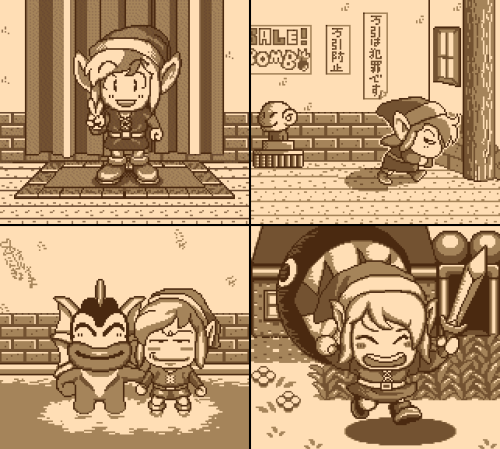
Four of the many photographs you can
collect during the game.
I'm rating this as a Gameboy Color game (not the original,) so you have to excuse my enthusiasm, but this game is really beautifully done. Everything is clearly visible, easily discernible, and most importantly pretty to look at. Each dungeon is unique and has its own theming elements. Little additions like the fact that Link does a flip when he jumps add a bit of style and charm to the game. Rather than defaulting to the monochrome dungeon style, Nintendo used the color elements really effectively. The designers got around the lack of detail by offering animated cutscenes and photos, which gave a bit more depth to the graphics and let you really see what Koholint Island looked like up close. Taking into account the age and the console, there is literally nothing that I would change about the graphics in this game.

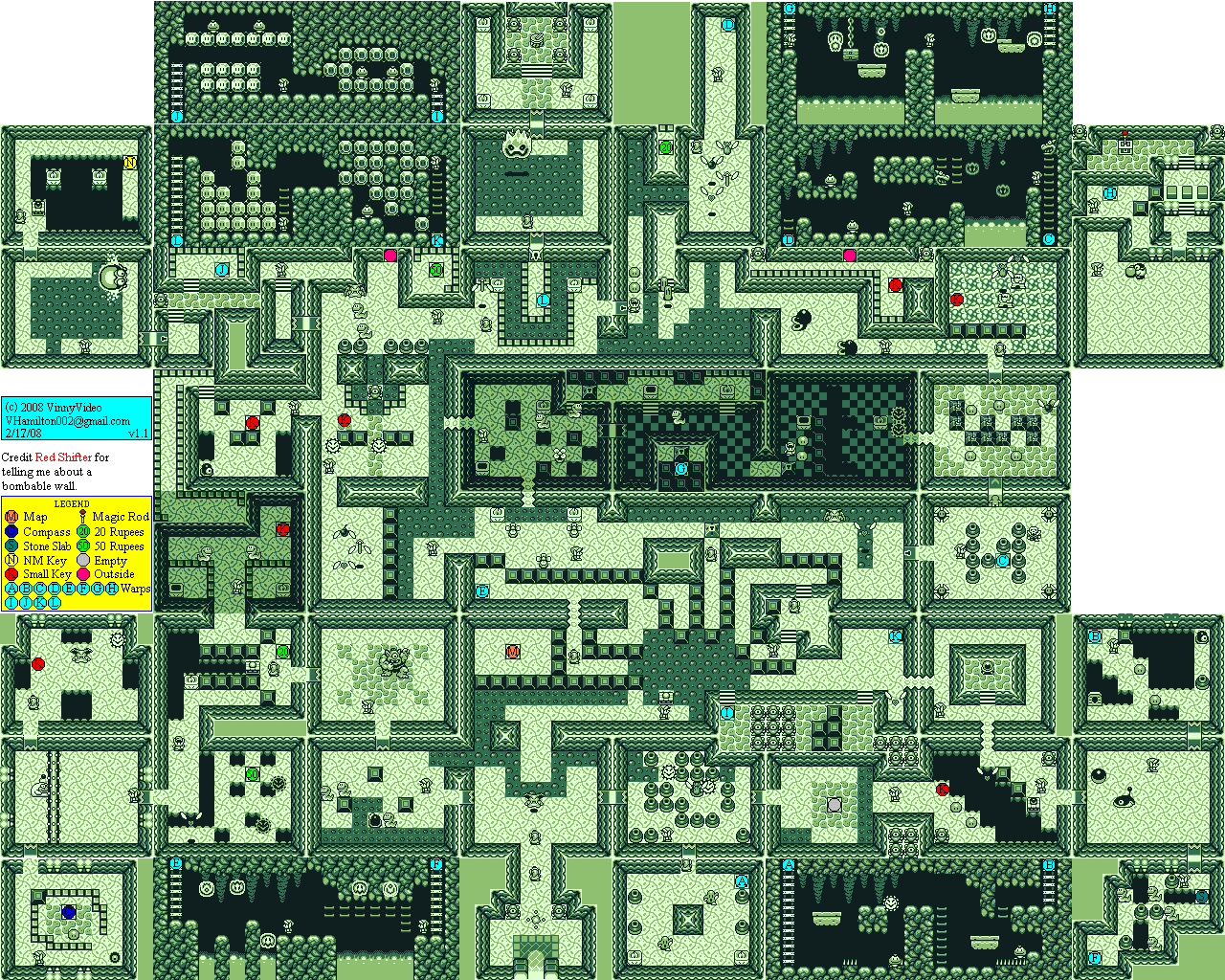
HOWEVER, I have to include map design here. I didn't love the random holes all over the place you could fall into - it didn't add anything to the game except frustration. Sometimes it was hard to place where you were in the map, which made it kind of time consuming and irritating to get around. The map itself was interesting and fun to explore, with diverse regions which all had something different to offer.
Link and Marin chat.
Charm/Nostalgia Factor: 18/20
Pretty much straight up, all Zelda games are going to get a really high mark in this score. Because the plot leaves you thinking about the ending and what it meant, I expect I'll come back and play this another time and look for more clues as to what is going on. The fact that it's a Gameboy game might have meant that it didn't have the exposure of the other Zelda games, but I think anyone who's played this one will probably love it forever. That said, as much as I hate to say it, you do kind of miss the "save Zelda, get the triforce" plotline - higher marks in plot, lower marks in nostalgia.

Story/Concept: 18/20
Oh, that zany Nintendo!
Is it an epic journey? No. Are hours and hours dedicated to plot exposition? No. Does this game have an amazing plot? Yes. Any game that leaves you wondering what the hell happened and what it all means is worth something, and this concept is absolutely and totally one-of-a-kind. Who else but Nintendo would put a multicolored flying whale in an egg on top of a mountain and make that be the basis for a game? It's ballsy, and it paid off. I really enjoyed it. I would have liked a little bit more plot exposition and conversation with NPCs, but this game did the job anyway. Link even has a hint of a love interest in this game, which is a level of development not even nearly seen to this point. He has conversations with NPCs, which has never really happened before. I see shadows of Ocarina of Time's greatness in this game, and for that reason alone it gets nearly top marks.

Overall: 85/100
This is a wonderful game, even though it's much less mainstream than it deserves to be. It's absolutely up there with the classics of the Zelda series in quality, and introduces many elements that have yet to be matched by later installments. Unquestionably worth a play. 


We're finally on to what is considered by many to be one of the greatest games of all time - the Ocarina of Time. As I've played Ocarina of Time well over a dozen times and it's not hard to find a detailed playthrough/review of the game, I'll be working my way through the Master Quest edition. First, of course, I have to beat Zelda II. Stay tuned - same geek time, same geek channel!

"Wind Fish? I woke you up! Can I get a tow back to Hyrule or something? Anybody? Hello?"

Link's Awakening Part 3: Link, the Hero of Douche.

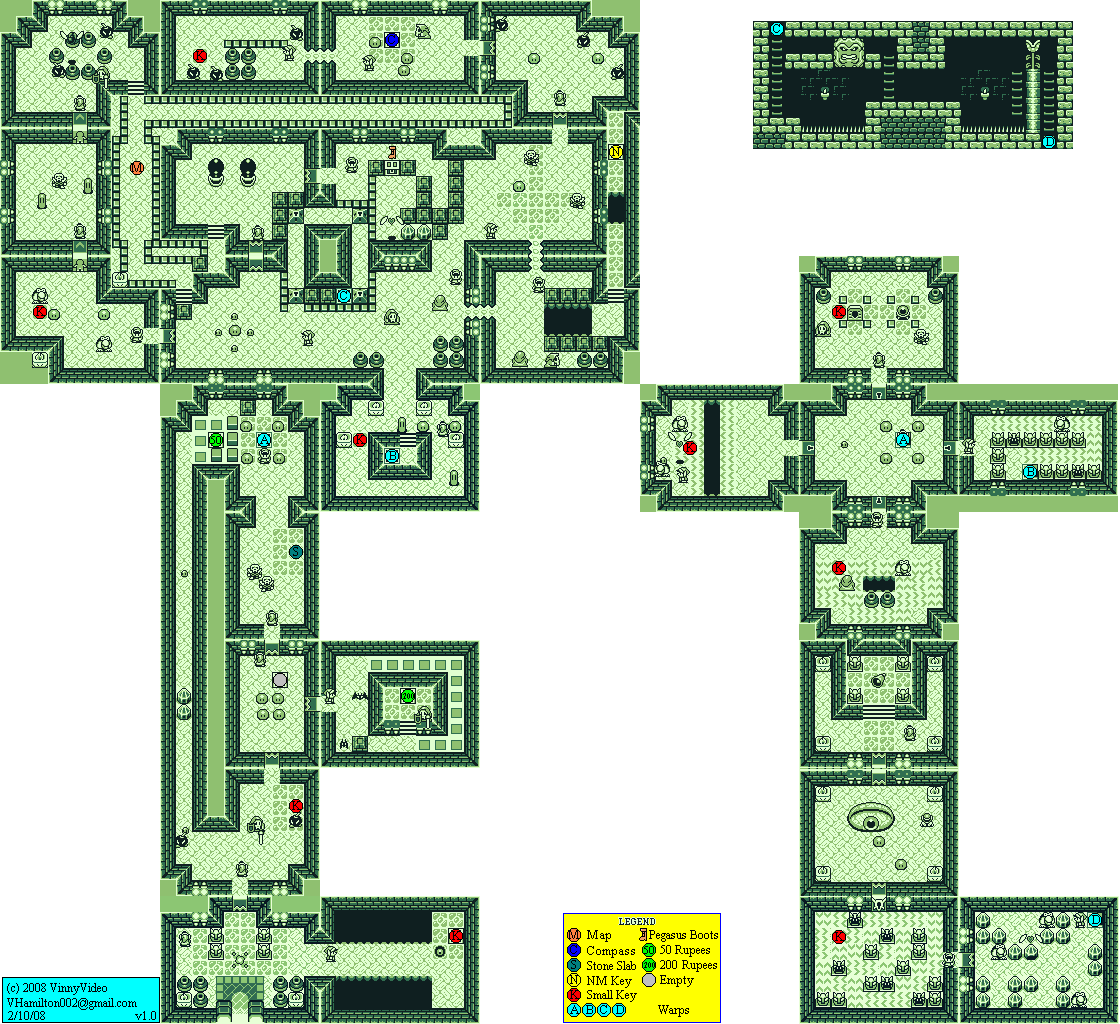
Turtle Rock, Dungeon #8. It's big.

When last I left off, I was working through the dungeons in this game. I’m really impressed by the complexity of the dungeon layouts – they’re totally unique, tricky, and remarkably complex. There’s a lot of work with layers and different levels, and much like in the first Zelda game, it’s really more about figuring out how to get to a room that you see on a map than just walking through the dungeon solving puzzles. That makes for an interesting challenge, but also a lot of backtracking which can get a little bit tedious after a while. This is a game that is much more puzzle and much less hack-and-slash; if your idea of a perfect Zelda game is Twilight Princess, you might find this game a little bit too frustrating for your liking. 

Anyway, that said, something interesting happens in Link’s Awakening that you don’t even begin to see again until Twilight Princess – the bosses all have something to say to you, and their short statements start to reveal a very unsettling plot which probably rivals Majora’s Mask in sadface quality. 

If you’re planning to play the game and don’t want to get spoilered, I guess stop here? (Note that this is the first Zelda game with a complex enough plot to warrant a spoiler warning.)

"Yeah! I'm a hero! I kill everybody!"
As you progress through the dungeons, the bosses start to tell you things about the island and why they’re trying to stop you from getting to the instruments which will wake up the Wind Fish. It seems that whoever wakes up the Wind Fish will inadvertently destroy the entire island and all of its inhabitants – they are, in fact, all a part of the Wind Fish’s dream, and don’t exist in the real world. Even after making friends with the inhabitants of Koholint Island, Link doesn’t seem too bothered by that, which is probably the most disturbing thing in the entire game. 

After you collect all eight of the instruments, you go to the Wind Fish’s egg (oh, Japan) and play the Ballad of the Wind Fish to make a crack in the egg. Inside, you fight a Nightmare which changes into familiar forms, including Aghanim and Ganon from a Link to the Past. It’s a pretty awesome final battle. Once you beat the Nightmare, it expresses despair at the fact that the island is going to disappear and dies. Link’s not bovvered. Nice guy.

"I'm so glad I destroyed the island to get this bit of wood back!"
The ending sequence is literally the saddest thing I’ve ever seen. The Wind Fish wakes up, tells you the island is going to disappear because it’s the nature of all dreams to end, and then you see scenes of the people of Koholint Island (and eventually the island itself) disappearing into nothingness. Link is blown out of the egg by a water jet, wakes up floating around on the remains of the boat he was in at the beginning of the game, and looks up to see the Wind Fish flying by. He grins at the fish and bobs around on the raft, land nowhere in sight, as the credits roll. 

Yeah, bro, this is way better than that stupid island.
If you beat the game without losing a single life, Marin (the girl who rescues you at the beginning and slowly develops a crush on Link over the course of the game) is shown with wings at the end of the credits, implying that she escaped the island or something. The DX version shows a seagull, implying Marin got her wish of turning into a seagull and flying away to see the rest of the world. Basically, Link’s actions either kill, mutate, or turn into a seagull the girl with a crush on him. Now that’s a guy to take home to your mum.  

Basically, the game is great, but it pretty much turns Link into the biggest jerk of all time. This is somebody who would rather see the entire population of an island cease to exist than to not return to Hyrule – assuming he even gets to Hyrule, since it doesn’t look like there’s a rescue squad coming his way at the end of the game. I’m pretty sure my timeline is going to feature this Link dying at sea, never to be found. 

Here's the "perfect" DX ending, if you're interested.

Anyway, next post I’ll be going into the review of this much underrated Zelda game, and hopefully I can convince you gentle readers to either find a cartridge or a ROM so you can give it a try! 

Monday, January 17, 2011

Link's Awakening Part 2: Let's talk about slime.

I'm now three dungeons into this game, and I can genuinely say that I haven't had this much fun with a game for a while. It's not exactly Halo: Reach, and it doesn't have the complexity of Twilight Princess, but it's a game which you can honestly pick up just about any time, play for ten minutes, and put down. That's the beauty of games designed for the Gameboy - in a very real way, they're designed for car trips and not for marathons, so they have to be 100% entertaining all the time.

Even Link likes plush toys.
Some features which I've noticed (and enjoy) about this game are the inclusion of lots of features which later made it into Ocarina of Time. For example, there's an extensive trading quest which you can complete (starting with a Yoshi doll, which you win from a crane machine game - huh) and "magic seashells," of which you find twenty and in return receive a better sword; this "find and gather" quest was repeated in Ocarina of Time as the Golden Skulltula hunt. There's even an ocarina which you can learn various songs with (although mostly they're just for fun, not practical purposes.)

Secret Seashell
There's also about 5000 references to the Mario series in this game. TheScottishAlien suggested that this was because Link's Awakening was Nintendo's flagship Gameboy game, and so it was important to them to blend as many of their popular franchises together as possible. I'm inclined to agree, although wikipedia expands on this a little:

"Link's Awakening features non-player characters who help the player figure out where to go next, including Ulrira, a shy old man who communicates to Link exclusively by telephone. Other characters Link meets on his quest include cameo characters from other Nintendo titles, such as YoshiKirby, Dr. Wright (renamed as Mr. Write) from the Super Nintendo version of SimCity, and exiled prince Richard from Kaeru no Tame ni Kane wa Naru.[16][17][18] An enemy from the Mario series called Chomp was included after a game programmer implemented the ability for Link to grab the Chomp and take it for a walk. The inclusion of characters from other series is described by Tezuka as a result of the game being developed in an unrestrained way. Tezuka joked that these inclusions made Link's Awakening like a parody of The Legend of Zelda series.[17] The island is also inhabited by characters who break the fourth wall; for example, little children inform the player of game mechanics such as saving, although they have no idea what this means."
The goal of this game is to wake this thing up.
It can't take itself seriously.

Link's Awakening is described as the first game in the series to "have a proper plot," in the words of Eiji Aonuma, despite the fact that it's "like a parody" of the Zelda series. I would probably consider this to be the first Zelda game which would be universally loved by modern fans of the series  - while Link to the Past was fun, it doesn't really combine all the Zelda elements of platforming, puzzles, plot and silliness quite as well as Link's Awakening does.

Anyway, on to the actual gameplay.

Link's Awakening works on a two-button system - you can equip any item (including sword and shield) to one of two buttons, A and B. This allows for tons of possible combinations, some of which allow for different abilities - for example, Pegasus Boots+Roc's Feather results in a long jump, Pegasus Boots+Sword makes Link run forward with his sword out, etc. This makes Link's Awakening much more complex in many ways than either its predecessors or successors.

Slimy eye, ew.
The "key items" of every dungeon are actually useful throughout the game - they're less gimmicky and context-specific than they were in Link to the Past. Rather than being primarily useful in one dungeon to get past one specific type of obstacle, the items which you collect in the dungeons are every bit as useful (and important) as the sword and shield that you receive at the beginning of the game.

The dungeons are well-themed, much moreso than any of the previous games. The third dungeon is opened with the "slime key" and is called the Key Cavern. The boss of the dungeon is a slime and the dungeon is full of little slime enemies, and the dungeon itself is full of locked doors and requires well over ten keys to complete it. (The dungeon layout also looks like a key.)

It's the Key Cavern. It looks like a key.
What else do you want?
This is the first Zelda game in which every single dungeon has its own little tune (all of which, so far, are very well composed,) and the puzzles are significantly more pervasive. Unlike the Link to the Past, in which the dungeon is actively trying to kill you and the enemies are just decoration, the spiky wall factor has been toned down in favor of complex rooms which require some thought to figure out how to get through. As in the original Zelda, keys are usually acquired by killing all of the enemies in a room, which can be just as challenging as trying to survive the room in the Link to the Past. Every dungeon is preceded by a small quest through a mini-dungeon of some kind, adding some interest to the game and breaking the monotony of the quest.

In short, I'm enjoying this game very much and I hope to finish it in the next week or so. Stay posted!

Monday, January 10, 2011

Link's Awakening Part 1: Somebody explain to me why there are goombas and chain chomps in this game.

Link tries to remember which one is "fore" and which one is "aft."
Unlike the three previous games, Link's Awakening introduces a land outside of Hyrule, away from Princess Zelda and Ganon. Instead, it takes place entirely on an island known as Koholint.

The game opens with a short scene of Link fighting against a storm on a little sail boat. Apparently, being the hero of Hyrule, he thinks a bit of experience with a raft in the Legend of Zelda is more than enough for some seafaring excitement.

He's wrong. The next scene shows Link alone on a beach, sans equipment or raft, with a girl leaning over him in concern. Link wakes up in the girl's house, and she introduces herself as Marin. She lives with a man, Tarin, and although their relationship is never explicitly stated, both characters come back in the Ocarina of Time as Malon and Talon (alternate romanizations of the Japanese names,) a father-daughter duo who run Lon Lon Ranch in the centre of Hyrule.
Marin checks to see if Link has anything good on him.

Marin tells Link that he should go down to the beach where he shipwrecked if he wants to try to salvage anything he might have lost, and Tarin gives him a shield which he says must be Link's because it has his name on it. (I guess Link has a label gun back at home.)

After Link recovers his sword from the beach (which also has his name on it, proving the label gun theory,) the adventure begins in earnest.

Must be part Rottweiler.
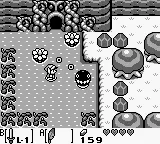
There are several unique features of this game which become immediately apparent after you explore a little bit. Link's jumps are now much more acrobatic; he does a little flip in the air during each one, just like in Majora's Mask. Exciting stuff. Something else which you quickly discover by wandering around the island is that stuff here is weird. For example, there's a lady with a pet chain chomp tethered outside her house (which tries to eat you,) but she's convinced it's a dog and has named it BowWow.

Kaepora Gaebora
Once you start heading in the right direction, you meet another familiar face from the later Zelda games - Kaepora Gaebora, the helpful (?) owl sage from Ocarina of Time and Majora's Mask. He serves the same purpose in this game as he did in OoT - he guides you to the right places. Kaepora Gaebora tells you that the only way to get off the island is to wake up something he calls the Wind Fish, or else you'll be stuck here forever. The Wind Fish is sleeping in an egg on top of Mt. Tamaranch in the north. In order to do wake him up, you have to enter the dungeons and collect eight magical instruments, which together play The Ballad of the Wind Fish, which is supposed to wake the Wind Fish up. Makes sense, I guess.

An interesting gameplay element which Nintendo decided to add to this game is the presence of random power-ups which drop from enemies a very small percentage of the time. One of these is called the Guardian Acorn, and it halves the amount of damage you take for a limited period of time. The other is called the Piece of Power (which looks  exactly like a piece of the Triforce - I was pretty confused the first time an enemy dropped one,) which doubles your attack damage for a limited period of time. This game can get a little bit hard, so both power-ups are very useful when they come up.

Another interesting addition in this game is the necessity of finding keys to the respective dungeons before you can enter them. The first dungeon is called Tail Dungeon, and inside you receive the most useful item in Zelda history - the Roc's Feather. It lets Link jump on demand for the very first time, which is awesome. The bosses of this game are called Nightmares and the first of these looks very much like the third boss of a Link to the Past, the crazy caterpillar thing that you have to hit the tail of to kill it. Easy.

When you win, you receive the first instrument, called the Full Moon Cello.

That's it for my brief introduction to Link's Awakening! I hope to have another one up in the next couple of days or so.

Thursday, January 6, 2011

Link's Awakening: Toto, we're not in Hyrule anymore.


Title: Link's Awakening (Yume o Miru Shima, or "The Dreaming Island" in Japanese)
Original Release: June 6, 1993
Game #: 4
Chronologically: #4, Young Link timeline


The first three Zelda titles were all distributed on Nintendo's main consoles, the Nintendo and the Super Nintendo. Link's Awakening was a whole new animal - for the first time, Zelda came to Nintendo's new and increasingly popular handheld console, the Gameboy. The original release of Link's Awakening was in black and white, which drove away many gamers who found it too difficult to distinguish between items and dungeon features without color. In response to those complaints, Nintendo re-released Link's Awakening for the Gameboy Color, changing a few gameplay elements and adding bright, vivid coloration. I will be playing this version of the game, called Link's Awakening DX.

Link's Awakening was very different from the previous entries in the Zelda series not only in its portable aspects. It was much less "seriously" a Zelda game, more geared towards the young fans of the Gameboy. Nintendo makes many references to its other games - including Goombas as an enemy, for example - and breaks the fantasy setting of the other Zeldas by including phones and other pieces of technology. Nintendo also chose to combine side-scrolling elements and top-down gameplay in Link's Awakening, making for an interesting shift in the experience. 

This was also the first Zelda game to take place outside Hyrule, instead located in a mysterious land called Koholint Island. It was also the first Zelda game which didn't feature Princess Zelda or Ganon, thus totally changing the nature of the Zelda legend. Finally, and most interestingly (at least to me) Link's Awakening does not have a cut-and-dry happy ending. It is considered by many to be the saddest in the series, and the most ambiguous in meaning.

Graphically, Link's Awakening DX is impressive for a Gameboy game, but Link's Awakening is lacking in definition, making it difficult to play. Regardless, next to Pokemon, Link's Awakening was perhaps the most popular Gameboy game ever released, selling around 6 million copies worldwide.