Showing posts with label Zelda I. Show all posts

Thursday, January 13, 2011

TheScottishAlien's Corner - Zelda I Review

My good friend TheScottishAlien is embarking on a similar quest to mine and has just finished the first Zelda game. After discussing it a little bit, I realized we had very different opinions on the game's quality and so I asked him to complete his own review of the game which caused me so much grief and despair. (Also, he's a contrary bastard, and it would be just like him to love a game which I hated!) 


He's agreed to let me post it here (with some grammar edits) but if you're interested in following his progress through the Zelda series, visit his blog at blog.thescottishalien.com
TheScottishAlien Plays The Legend of Zelda
Now, when you read this review, make sure that you understand that I'm doing this from the perspective of someone wanting to try out this video game classic. While I am going to use modern rating systems (GT's /10), I'm not going to compare this to anything since Nintendo has already done a marvelous job of updating and reinventing the series time and again. This review is to be taken on the idea of replaying a video game classic and my impression of it.
Story
Not much is given to the story of this game other than a short little text after the title screen. It states that Princess Zelda has been captured, and you need to go collect triforce pieces in order to save her from Gannon.  


It's short, it's simple, and it's all that's needed. Unless you've lived under a rock for the past 24 years, I'd say it's pretty safe to assume that you know what the Zelda franchise is all about, so the idea of needing an elaborate story for the very first game is quite unrealistic.  


In game, there isn't anything to hint towards any more of a story. Apart from a few lonely sages, the land is fairly sparse when it comes to chatty NPCs, however this isn't where you got the story in the late 1980s.
For video gamers at this time, if you wanted the whole story you had to go to the source, Nintendo Power (or as it was called at this time, Nintendo Fan Club News). Unfortunately, it's very hard to find these still around - however, I do have a lovely snippet from Vol 2 (Vol 3 was all about LoZ :( ).  As you can read, more story is given in this page than the entire game has to offer. 


So, my impression of the story is that it's nice enough to get you into the game with a purpose, but after that expects you to look as hard as you want for more understanding of what you're doing. If you're just there to play video games, then you can just stick to the console; but, if you're more interested in the lore, then you need to get a magazine subscription and do your homework.
For story, I give a 7/10.
Design
The layout of the land seems simple and boring at first but after battling it out and upgrading a few pieces of equipment you can really explore some of the more hidden corners of the overworld and see how big and elaborate this game really is.  At first you get 2 or 3 different kinds of enemies, each with about 2 stages of difficulty.  This plus one large boss make the first 4 dungeons rather simple and pleasant and make for a nice introduction into the game.  After that the game decided to punish you for thinking it was too soft by introducing mini bosses (basically old bosses) as well as rooms swarming with enemies.
There is also a lot of depth to this game that you never notice until you pick up a game guide or a map.  Hundreds of secret items and rooms are everywhere for you to discover, most of which are impossible to discover by accident.  In fact most of the items that you need to complete the game are so well hidden that I doubt anyone could do it without a little help.  That said, once you know what to do it really sticks with you, I think I could now complete this game in half the time without any help since all the secrets have now been discovered.  However Nintendo seemed to have anticipated this buy making a second play-through possible that remakes every level and location, making for almost two games in one.
For Design I give 9/10
Gameplay
After playing a few of the older titles I'd have to say that LoZ is probably on of the most intuitive and sophisticated control schemes there is.  With only two buttons to work with and a sticky D-pad a lot can done in this game.  Items like the boomerang allow for diagonal shooting which the return path can be controlled slightly allowing for some skillful maneuvering.  Also the general fighting can be taken to a whole new level with the idea of half steps; since NCP's only walk on full squares but link can walk in half steps this allows for some very skillful swords play against some of the tougher enemies like the Darknut (DAM YOU DARKNUT!).
After watching some more skilled players on youtube I can see that LoZ is one of those games where you can really good at with practice.  At one point in the game you walk into a room with 5 Blue Darknuts and 4 dragons shooting fireballs at you.  The fireballs are random and unpredictable and the darknuts can only be attacked form behind.  This leads to one of the most finger intensive moments in my video gaming career, not only did i have to be constantly aware of flying fireballs but i was also trying to out maneuver and half step 5 different enemies at once.  And while frustrating, after completion and looking back this is one of my favorite moments in the game.
For Gameplay I give 9/10
Presentation
Luckily for LoZ, pixel games have come full circle by moving past looking like crap compared to modern games and ascended into the realm of art. Rather then most of this game coming off as cheap and boring, the nostalgia mixed in with the quaint and lovely scenes make for something very pleasing nowadays.  While it's true that most of the rocks and bushes are pretty unimaginative, and most dungeons are simple palette swaps but at the same time you can't help but smile every time you revisit a familiar lake or room.  Even mobs get reused a lot but that doesn't stop you from appreciating the simple 16x16 piece of art that is trying to kill you.
However, if your the type of person that can't see pixel art for the anything more then a forgotten style of video games then be warned.  In reality most of the colours and music are very over used and considering this will take you several days to complete do not be surprised if you feel your eyes begin to bleed pastel coloured blood after a few hardcore hours of play.  With only 4 songs which each consist of about 20 sec of notes on repeat, also don't be surprised when you can't hear anything but the music even when the game is off.  Thankfully nostalgia helps to numb you to most of this which results in you spending most of the day that your not playing the game humming or whistling the main tune.
For Presentation I give 6/10
Overall
My overall impression of Legend of Zelda is that it's an absolutely amazing game that I really enjoyed playing.  Despite hard times and tough difficulty curves all the memories I have of this game are fun ones.  The story was non existent, the design was solid, the gameplay was simple and the presentation make my eyes bleed BUT it was still one of the funnest games I've played in a long time.  Now most of this could be chalked up to nostalgia pulling the wool over my eye and that may be true however I still do remember enjoying myself and after all is said and done that really is what video gaming is about.
For Overall I give 8/10
It is important to remember two things when playing this game: (1) Most video games at this time were not meant to be played casually, let alone be completed without difficult.  If you were stuck or having a really hard time that was what they wanted you to feel. and (2) Nintendo make a ton of money of hiring professional gamers to be advisers that you could phone in and talk to about how to beat certain levels and games.  just check out the above ad.  If your serious about wanting to play this game then I highly suggest finding a few dungeon maps to keep by your side.  Don't think of it as cheating since any kid in the 80's would have bought a game guide in order to complete it, it's just not possible otherwise.
References
http://imageevent.com/gamescans/nintendofanclubnews

Tuesday, February 2, 2010

The Legend of Zelda Conclusion: Too many enemies, too little point.

Gameplay/Difficulty: 5/20
Like I said before, I would consider this game very nearly unplayable without save states - not because it takes time to learn the weaknesses of each enemy or the puzzles are too complex to solve in one go, but because a lot of the time your survival comes down to luck rather than skill. The sheer number of enemies in each room made the game mostly about staying alive long enough to get through each level, which was frustrating and made the game feel more like a chore than entertainment.

I give The Legend of Zelda a 5 instead of a 0 mainly because while the gameplay was repetitive, boring and stupid-hard, the controls were very intuitive and could be easily learned in a matter of minutes.


Music/Sound: 7/20
The Legend of Zelda has a total of 4 pieces of music - the overworld theme, the title theme, the dungeon theme, and the theme of Ganon's Tower. Every single one of these (except maybe the title theme) becomes annoying enough that you mute your game every time you turn it on.

However, I gave this game a 7 instead of a 0 because the score (if you can call it that) is iconic and recognizable to even the staunchest non-gamer. The tracks themselves are well composed even if they do make you want to shoot your speakers. Basically, the music suffers more from repetitiveness than lack of quality.

The sound is fairly unremarkable and is basic NES quality. Not much to say here. Notable is the "Zelda secret music" - the little jingle that plays every time you figure out a secret or solve a puzzle. It can be found in almost every other Zelda game since and is incredibly recognizable.


Design/Graphics: 5/20
Yes, I realize that for 1986 it was a graphical gem. I know. I get that. That's why it gets some marks. I'm sorry, this game is ugly. It really is. Not simply for the graphics themselves, but the color palette - the lime green dungeons, the orange snail-boulders, etc, etc. Everything you see is a palette-swap of something else, every dungeon room you've seen has been seen elsewhere. The game isn't just boring and frustrating to play - it's boring and frustrating to look at.


Charm/Nostalgia Factor: 15/20
This is where The Legend of Zelda really shines. It's iconic. It was revolutionary. It was the first game to use battery-powered saves instead of a password system, allowing for your saved game to be totally unique from anyone else's. It spawned its own television show, Spaghetti-O's ripoff, and merchandise. Link is instantly recognizable to anyone who hasn't been living under a rock for the last twenty years. Every convention on the entire planet features at least one terrible Zelda cosplay. It is, in my opinion, the most important video game ever released, next maybe only to Super Mario Bros.

Unfortunately, this game sucks, so I can't really give it full marks.


Story/Concept: 10/20
The story is completely generic - get the shiny triangle bits, beat the giant blue pig, save the sadistic Princess, yadda yadda. It only gets half marks because it had a great amount of potential which was only later realized in A Link to the Past, the Triforce is a cool magical item, and because I said so.


Total: 42/100
It's a terrible game with an immense legacy. Fortunately for us, Nintendo didn't stop there!

On to Zelda II: The Adventure of Link!

The Legend of Zelda Part 2: Okay, I saved the princess, does that mean I can stop playing now?

I could give you many excuses as to why this post has been so long in the making. I could tell you that school has been busy, or work has kept me away from Zelda. Unfortunately, none of them would be true.

I actually spent two weeks trying to finish the last two dungeons. Why did it take so long? Let me explain.

Every dungeon after about the 4th level consists of pretty much nothing except palette-swapped enemies and rooms. (Yes, you can even palette-swap a room, apparently!) Although the individual room layouts are completely identical from level to level except for the palette-swapped enemies that are in them, the layouts get increasingly more confusing and require you to bomb walls to get around a lot of the time. This is a Zelda staple and it wouldn't bother me except that there's no indication of which walls you're supposed to bomb.

As a result, every time you enter a room, you waste 2-3 bombs (of a maximum of 8, which eventually increases to 12 if you buy an upgrade) trying to find a doorway which may or may not be there, all while dodging so many enemies that they actually made my NES emulator lag. When you run out of bombs, you have to find and kill enemies which drop them, but unfortunately bomb-drops are not random like they are in the newer Zeldas and only specific enemies in a level have them. That makes working through each level pretty much the most tedious thing ever after about level 6.

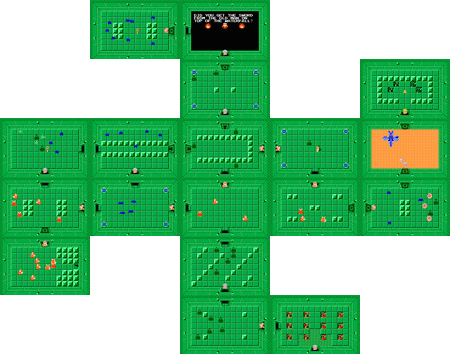
The last level in the game is Ganon's Tower, just like it almost always is. This is what took the vast majority of the last two weeks. Let me show you a map of the level somebody made on Gamefaqs in a vain attempt to aid any poor sucker who feels like playing this game:

http://www.gamefaqs.com/console/nes/file/563433/12037

Everywhere you see those black cracked holes, you needed a bomb to get through. This was the first time in my life I experienced having to draw a little map for myself in order to remember where I was going and where each door led.

After getting through the level, I have to say that Ganon is the worst final boss ever. Besides being a blue pig, he's boring. Basically, he flies around and shoots little balls of fire at you, which if you'd made it through the game in the first place you should be able to easily dodge by now. Just to up the challenge, they made him invisible, so you have to run around like an idiot dodging the balls of fire and swinging your sword. If you hit him, he turns visible for a moment and then continues with his attack pattern.

Eventually, if you catch him enough times, he turns red and you simply shoot a Silver Arrow at him and he dies. One hit, dead. If you didn't find the Silver Arrow in the level, you cannot beat Ganon, and will have to let yourself be killed and try to find your way back all over again.

After you kill Ganon and take the Triforce of Power from his grisly remains, you head back into a modified version of the generic Triforce piece room. There, Princess Zelda is trapped behind a wall of flames (which can easily be swept away by just hitting them with your sword, so I'm not really sure what the point of putting them there in the first place was except as one last "we hate you" from the programmers? Maybe they were hoping the player would have a nervous breakdown at the idea of having to go back into the level to find yet another useless quest item? The Japanese are a mysterious people.)

Anyway, you sweep away the flames, step up to Zelda and the Princess is saved! Yay! You've beaten the game! Surely, there's a grand ending sequence waiting for you! Surely, Nintendo will be calling your home phone number at any moment to congratulate you for your tenacity!

Not exactly. To the left you can see the entirety of The Legend of Zelda's ending sequence.

"Thanks Link, You're the Hero of Hyrule"? Gee, thanks Zelda.

...Actually, now that I think about it, it was Zelda who hid the Triforce pieces in the dungeons across Hyrule, right?


That's better.

Friday, January 22, 2010

It's not really a Zelda post, I know. Sorry.

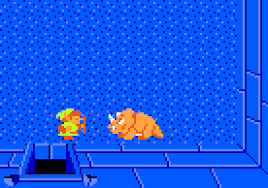
I'm still fighting my way through Zelda - things have taken a turn for the even more difficult. The creators of this game thought it would be really cool to make the boss of the last level be the sub-boss of the next level - sometimes in multiples. The situation displayed to the left (those are three versions of the boss of the second level, Dodongo) among other situations of increasing difficulty in this game has led me to use a TOTALLY ACCEPTABLE and charmingly retro approach that is TOTALLY NOT CHEATING to successfully beat the rest of this game without hurting myself or others.

They call him...the Game Genie.

If you're too young or too lame to remember the Game Genie, it was a system which allowed you to type in codes for your NES games which would alter the stats of your character, sometimes going as far as to make them invincible. Anyway, it's totally not cheating and is a fully legit and WIZARD way to get through a difficult game, so I'm rolling with it.

In any case, it helped me get from the situation above to VICTORY. The Dodongos also look uncannily like me after eating too much pie when you deposit a bomb into their stomachs, except cuter.


Anyway, this is not a real "finishing the game post," but I promise it is coming soon. I'm on the 7th level of the game and I'm pleased to report that after two remarkably monotonous levels, this one is a lot more puzzle-heavy - you even need to give a moblin a certain item (namely, a hunk of meat) in order for you to get through it, which is probably the very first "fetch quest" in history.

More later! Byeeeee!

Sunday, January 17, 2010

The Legend of Zelda Part 1: Save state. Die. Load state. Die. Load state...

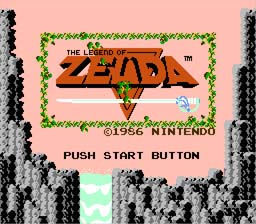
When you start up the Legend of Zelda, either on your NES or your emulator, you're greeted with the eternally nostalgic Legend of Zelda theme and (in my opinion) quite a lovely start screen (for 1986) showing a picture of the Triforce of Wisdom and the White Sword (the second sword you get in the game.)

Notice that, unlike the more modern Zelda games, there's no Master Sword in sight - the White Sword looks more like a sabre than the traditional longsword we're used to seeing Link with.

Anyway, I like watching the intro sequences to games, so I decide to hold off on pressing the start button for now. After a few seconds, the screen goes dark and the player is presented with what might just be the most inelegant translation I've ever seen. (I particularly like the random quotation marks. "Link"! Go "save" Zelda from the "evil" "Gannon!")

...Well, that does sound like an epic quest. How could I possibly say no? I'm off to retrieve Zelda's units with Wisdom!

After you press start, you're greeted with the usual "enter your name here" screen with three save slots. If you've ever played another Zelda game in your life, you'll know what I mean. It's not interesting or pretty to look at, so I'm going to skip right into the meat of the game.

Basically, about 90% of this game is spent wandering around the impossible-to-navigate overworld map, either A: trying to dodge enemies with half a heart left and subsequently dying, or B: charging into the fray with berserker fury, praying one of the fifteen Octoroks on the screen will drop a heart so you can avoid situation A. (Most of the time, they don't.) The aim of this is to find the eight monstrously terrible dungeons scattered around the map, along with a few shops and other secrets liberally sprinkled around.

The other 10% is spent inside said infuriatingly confusing and repetitive dungeons presented in a series of monochromatic color schemes. All the dungeons share the same piece of music, about 15 seconds long, which repeats ad nauseum. These two combined factors make most of the challenge really involve making it to the end of the dungeon before your brain starts leaking out of your ears.

There are puzzles of a sort in that you're often left running back and forth between nearly identical rooms wondering where in God's name the next key is, but mostly the aim of the game is the same as when you're outside - survive long enough to make it to the boss.

Fortunately, most of the bosses are easy enough to beat - the boss of the third "level" (as they call dungeons in this game) can be killed in one hit by strategic bomb placement. They tend to be a bit of a letdown on the whole after the hardship you endure fighting your way through the dungeon, though, and the limitations of the NES make boss fights less than inspiring. We're not even given a change of tune to mark the occasion, so the only indication you have that you're about to fight the boss of the level is a "roaring" sound effect you can hear in the room immediately before the boss level.

Plus, they never look very intimidating - check out Dodongo, the boss of the second level, above. His little stubby legs make him more cute than scary, which is just disappointing after all that work. Seems to be a trend with this game.

After you defeat the boss, the next room always has the same layout regardless of the level, as you can see to the left. The only thing in there is the level's Triforce piece, and when you collect it you're restored to full health (an absolute blessing in this game, trust me) and kicked out of the dungeon with no direction as to where you're supposed to go from there. Thanks, Nintendo.

I've only played the first four levels so far (half of the game), and I think I should say here that I would consider this game completely unplayable if I wasn't doing so on an emulator. (Don't worry, boys and girls - I own a legal copy.) The tears and frustration our gaming ancestors would have had to endure to beat this game are absolutely unfathomable; almost as unfathomable as why in God's name this game was ever blessed with any sequels at all.

Giving credit where credit is due, though, this game was completely revolutionary when it came out. It was the first game to include a battery-powered save feature instead of the password system which was previously popular. Zelda opened the door to the heyday of the console RPG in the 90s. For the time it was released, it was incredibly complex and detailed - nobody had ever thought of hidden keys or caves which could only be revealed if you bombed the right wall, and the amount of little secrets in the game meant you could virtually play it forever. It was a beautiful game by 1986's standards, graphically.

Still, that doesn't mean I have to like playing it.

Next post, the THRILLING CONCLUSION of Zelda I, plus my final review of the first game in the series.

Saturday, January 16, 2010

The Legend of Zelda: It's old and it shows.

Title: The Legend of Zelda (Zeruda no Densetsu)
Original Release: Feb. 21, 1986
Game #: 1
Chronologically: #5, Young Link timeline

According to Wikipedia, the first game in the series is "set in the fantasy land of Hyrule, the plot centers on a boy named Link, the playable protagonist, who aims to rescue Princess Zelda from the primary antagonist, Ganon, by collecting eight fragments of the Triforce of Wisdom, a powerful artifact." I'm not really sure why they haven't updated the basic plot in 24 years, but if it works for Mario I guess it works for Zelda, too.

For 1986, the graphics must have been pretty good, but honestly - the game looks awful. It really does.

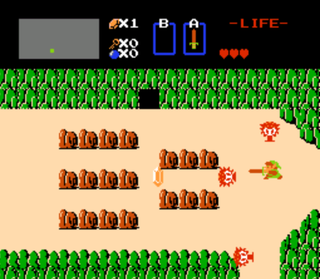
For example, if you had to guess without context, what would you say this was? My first guess was a giant snail.


Actually, they're boulders, as you can see in the image to the right. At least, I think they're boulders. I'm still not completely convinced.

The basic layout of the screen is very simplistic, but not unfamiliar to the modern Zelda player. You can see an overworld map (kind of) in the top left of the screen, a section which counts the number of rupees (Zelda's currency), keys, and bombs the player has, and a section which directs the player to press A to swing Link's sword and B to use whichever quest item Link has equipped.

The Legend of Zelda doesn't use the traditional "HP" system to keep track of Link's health, and instead gives him a number of hearts (you can see those in the top right of the screen) that are taken away when Link is hit by an enemy. When all his hearts disappear, Link dies. There are a number of ways to restore his hearts in-game, and as Link progresses on his quest it's possible to increase his maximum number of hearts.

The Legend of Zelda series has changed a bit over the years, becoming more RPG-like in its more recent incarnations, but the first game in the series is very much a dungeon-crawler with puzzle elements. It's very non-linear - you can go where you want, when you want, and tackle the dungeons in any order you wish (although it's easier to defeat some of them having defeated others first, kind of like Megaman.) It's even possible to get to the final battle without having a sword!

Chronologically, there are many different arguments for when the first Zelda game takes place, but I'm most convinced by this theory, which is the one I'm using. (There have been some strong arguments made that Twilight Princess fits into the Young Link timeline, somewhere down the line, and Spirit Tracks is after the Phantom Hourglass on the Adult Link timeline.) This theory suggests that the Legend of Zelda is the third game on the Young Link timeline, and the fifth chronologically.

So that's the basic overview of this game. My next post will be (hopefully) my experiences actually playing the game, followed by my review of this title. Wish me luck!