Showing posts with label A Link to the Past. Show all posts

Thursday, January 6, 2011

A Link to the Past conclusion: The first real Zelda.


Gameplay/Difficulty: 15/20
This game could be tricky, sometimes even frustrating, but never so much so that you didn't want to try again. The control system was easy to learn and intuitive; I liked that the shield blocked attacks without having to do so manually. Swimming was a nice addition and I enjoyed the sideways slash instead of a stab, making it much easier for Link to actually hit things. The spin attack was great, items were easy to use and intuitive to equip, and dungeons were uniquely themed and styled, which kept the game interesting.
The game was limited only really by 2D technology, although despite the top-down view, gameplay was dynamic and made use of levels. I would love to see a remake of this game in 3D.

Music/Sound: 15/20
Link to the Past has an incredibly iconic soundtrack, including the Dark World theme, which is the best overworld music ever. It can get slightly repetitive, but not anywhere near the mind-numbing quality of the first Zelda game. The quality of the sound itself was much better than the previous games, but it was still quite tinny due to sound chip limitations. The amount of music which was shoved on to this cart is genuinely remarkable and there are many memorable and beautifully done tracks. Once again, limited only by its age.

Design/Graphics: 15/20
Absolutely gorgeous graphics for the age of this game, like I mentioned before. Compared to what other companies were putting out at the time, Nintendo made Link to the Past with graphics comparable to games which would come out three or four years later. The colors are vivid and stylized, and the overall feeling of the game is bright and accessible. Unlike the first two Zeldas, objects are easily recognizable and the game is still nice (if not advanced) to look at after almost twenty years. Link to the Past has its own aesthetic style, matched only in cartoony cuteness by Wind Waker over ten years later. 

Charm/Nostalgia Factor: 20/20
A Link to the Past was the first time Zelda really came into its own. With a combination of stunning music, beautiful graphics, and accessible (if challenging) gameplay, A Link to the Past is the first Zelda game that many people my age and a little older can remember. It is truly unique and epic in scale and for that reason is among the very best of classic games.
Story/Concept: 15/20
A Link to the Past introduced new elements to the Zelda franchise, like the presence of the sages and the involvement of Princess Zelda (albeit limited) beyond just being a goal to achieve. NPCs are more involved, giving the world a much richer feel. For the first time, Link is given at least a hint of a backstory through his uncle’s involvement.

While still building on the traditional Zelda storyline, it’s impossible to give A Link to the Past full marks for concept. There is little innovation or originality in the plot, even if it is interesting and easy to understand.

Total: 80/100
A Link to the Past is a fantastic game for its age, both in concept and gameplay. Most of the few issues it has come because of age and technological limitations, and for that reason I would love to see Nintendo do a full remake in the future. Definitely worth playing for gamers young and old.

Now for Zelda: The Adventure of Link!

Sunday, August 15, 2010

A Link to the Past Part 2: No hearts, no fairies, no service.

Let's start from the top of the game. It's pretty standard Zelda - you enter your name of choice, then a scene opens of Link sleeping in his house. He receives a telepathic message from Princess Zelda asking for help, his uncle tells him to stay in bed while he handles the situation, and Link totally ignores him and follows.

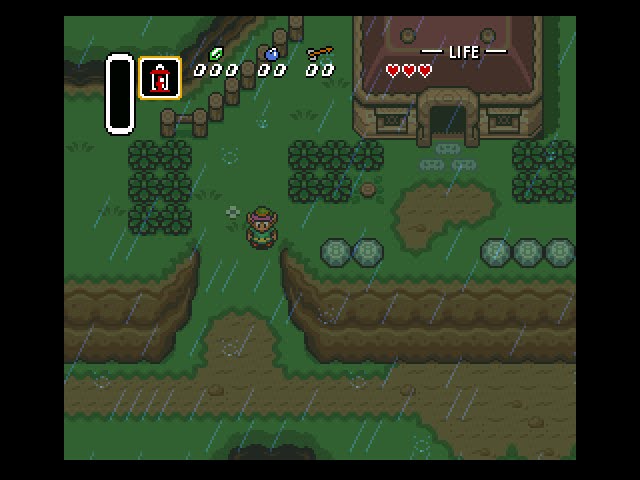
The first thing that really struck me about this game happened as soon as I walked outside of Link's house. The ambiance. There's rain, thunder and lightning, and foreboding music. I can't begin to express how big of a jump up this is from the previous games in the series, both of which had all the ambiance of an awkward dinner with your least favorite side of the family. Every dungeon has its own unique theme and looks completely different from any other dungeon in the game. One dungeon, for example, is extremely creepy and made largely of skeletons, while another is an icy palace covered in tiles which make Link slip all over the place, adding difficulty. My favorite dungeon takes place in a tower - many of the puzzles in it involve jumping down floors to land in the right spots, which is frustrating but fun.

The graphics, for 1991, were absolutely astonishing. There are games that were made at the end of the SNES's life that this game easily rivals in appearance, thanks largely to excellent graphical direction from the Zelda team. Just to give you an idea of what I mean, look to the right for a screenshot from a game released in the same year, Final Fantasy IV. There's really no comparison.

The musical score is vastly superior to either of its predecessors. One track in particular, the Dark World overworld theme, stands in my mind as one of the greatest video game tunes ever composed. There's a separate tune for dungeons in the Light World and the Dark World, as well as unique tracks for special areas on the map - the Lost Woods, Fairy Fountains, Kakariko Village, and Hyrule Castle. There is, of course, also the classic Zelda tune for the Light World map, as well as a special track for the end of the game and the final boss battle with Ganon.

Getting down to the nitty-gritty of it, the gameplay changed a lot from Zelda II. Nintendo (wisely, in my opinion) ditched the side-scrolling aesthetic of the previous game in favor of the top-down view they used for the first Zelda. Swordplay is much easier due to the fact that rather than just stabbing, Link's sword now slashes in a semi-circle in front. Link can now run diagonally, sprint, and pick up and throw bombs. Rather than needing to duck up and down to use the shield like in Zelda II, the shield acts automatically as long as you're facing in the right direction.

Arrows in this game are exhaustible, just like bombs, and both drop WAY more frequently from random enemies and pots. It's much easier to regain health than in the previous games - there are extra hearts lying around pretty much anywhere, and enemies drop them often. This Zelda also added a familiar helping hand - the heart piece. These are optional items that you can collect throughout the game. If you collect four, Link's heart meter goes up by one. Heart pieces became a standby in almost every Zelda game afterwards. There are three magic spells that you can collect in the game, all of which are necessary to open the way to different parts of the adventure. They're all attack spells, and while they use a LOT of MP, they can be really helpful in certain situations.

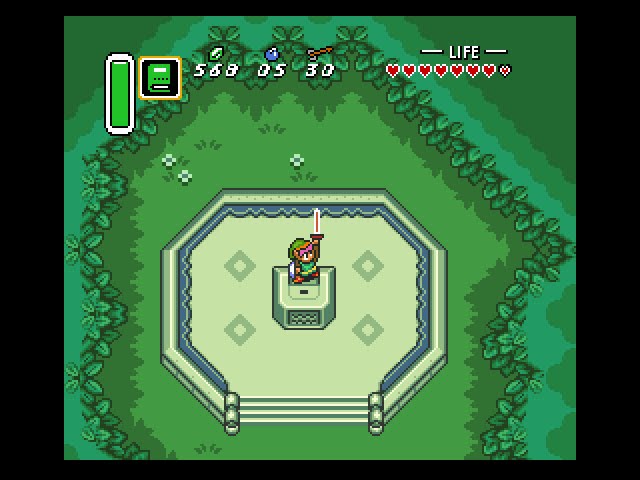
This game features the very first appearance of the Master Sword, and like in the original Zelda, Link can shoot projectiles from it when he's at full health. Unlike in the original, though, he shoots beams of energy instead of weird little sword things. These are awesome and kick everybody's ass from a long way away. You can also now catch helpful fairies in a bottle, which will revive you from death! Hooray! These are standbys of the series, and have probably saved every single modern Zelda fan's ass at least once.

The bosses in this game are incredibly difficult - they require a lot more strategy than in any of the previous games. Unlike in the first game, it's not about surviving the enemies in the dungeon to get to the boss. You have to survive the many traps and pitfalls in the dungeon this time; the enemies are really just decoration.

In summary, A Link to the Past added pretty much everything to the series that we recognize about it today. Anything that you might mention as gameplay elements that are distinctly Zelda-like probably either came to fruition here, or was developed for this game. Rather than being frustratingly hard, A Link to the Past is a brain-teaser which will keep you thinking and provides real satisfaction whenever you figure anything out.

Next post: the review. Watch for it.

A Link to the Past: Oh my God, it's actually fantastic.

Title: The Legend of Zelda: A Link to the Past (Triforce of the Gods in Japan)
Original Release: Nov. 21, 1991
Game #: 3
Chronologically: #8, Young Link timeline

After a long, four-year hiatus, Zelda reappeared once again on the Super Nintendo. Nintendo's new console was far superior in every way to the NES, allowing for graphics and a new complexity of gameplay that awed the anti-social basement dwellers of the time. A Link to the Past was released in Japan almost exactly a year after the SNES emerged in Japan, making it one of the first big-ticket games that this new gaming generation would experience.

In the production of A Link to the Past, the original team from The Legend of Zelda were back with a vengeance. Technology had finally caught up with their vision of what they wanted the original Zelda to be, and they used the new power of the SNES to make that vision a reality. Many gamers today still consider A Link to the Past to be the true sequel to The Legend of Zelda, as the Adventure of Link was produced by an entirely different team with a distinctly different feel. The game itself was almost twice as big as the average SNES game at the time, taking up a 1MB cartridge all to itself. This allowed for a vast, expansive world to explore, as well as a much larger soundtrack.

A Link to the Past is, I think, the very first modern Zelda game and the oldest one which I would recommend anyone play. It introduced several of the Zelda standbys which modern gamers recognize - three introductory dungeons, sidequests, the first appearance of the full triforce (all three pieces), the first Zelda 'gimmick' (in this game, two parallel worlds) - and technology had progressed to the point where, for the first time, complex and even challenging puzzles were possible. A Link to the Past was immediately successful, and to this day has sold over 4 million copies. It has been re-released on both the GBA and the Wii's Virtual Console.

For the first time in a Legend of Zelda game, a significantly more complex (although very familiar to today's gamer) plot was introduced. From Wikipedia:

"A young boy named Link is awakened by a telepathic message from Princess Zelda, who says that she is locked in the dungeon of Hyrule Castle. As the message closes, Link finds his uncle ready for battle, telling Link to remain in bed. After his uncle leaves, however, Link ignores his uncle's command and follows him to Hyrule Castle. When he arrives, he finds his uncle seriously wounded. Link's uncle tells Link to rescue Princess Zelda from her prison, giving him a sword and shield. After his uncle dies, Link navigates the castle and rescues Zelda from her cell, and the two escape into a secret passage through the sewers that leads to a sanctuary.

Link is told by a man in the sanctuary that Agahnim, a wizard who has usurped the throne, is planning to break a seal made hundreds of years ago by the Seven Sages. The seal was placed to imprison a dark wizard named Ganon in the Dark World, which was once the Sacred Realm before Ganon invaded, obtained the legendary Triforce and used its power to turn the realm into a land of darkness. Agahnim intends to break the seal by sending the descendants of the Seven Sages who made the seal into the Dark World. The only thing that can defeat him is the Master Sword, a sword forged to combat evil.

To prove that he is worthy to wield it, Link needs three magic pendants. After retrieving the pendants, Link takes them to the resting place of the Master Sword. As Link draws the sword from its pedestal, Zelda telepathically calls him to the Sanctuary, informing him that soldiers of Hyrule Castle have arrived. Link arrives at the Sanctuary moments after the soldiers have vacated, where he learns from the dying man that Zelda has been taken to Hyrule Castle. Link goes to rescue her but arrives too late; Agahnim sends Zelda to the Dark World. Link then defeats Agahnim in battle but is subsequently also sent to the Dark World.

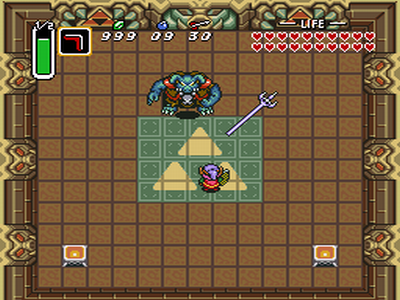
To save Hyrule, Link is required to rescue the seven descendants of the Seven Sages from dungeons scattered across the Dark World. Once the seven maidens are freed, they use their power to break the barrier around Ganon's Tower, where Link faces Agahnim again. After Link battles Agahnim for a second time, Ganon rises up from Agahnim's body, turns into a bat, and flies away. Link chases him, finally confronting him inside the Pyramid of Power in the Dark World. After a battle resulting in Ganon's demise, Link touches the Triforce and restores Hyrule to how it was before Ganon intervened."

As you can tell, the plot is very similar to later games like Ocarina of Time (seven sages, Ganon has an alterego, Sacred Realm, etc.) but for 1991, this was a very impressive amount of plot for what was essentially a puzzle/adventure game. It doesn't compare with the plot of some of its contemporaries (Final Fantasy IV, for example) but it still stands up as a classic of gaming storytelling.

There's your introduction to Link to the Past! My next post will highlight some of the features of the game in more depth, followed by a review. I promise it won't take four months this time. Seriously.