Sunday, November 13, 2011

Majora's Mask Part 5: Link wins a horse race, beats up a giant stalchild, turns into a mummy, gets the ugliest shield in Zelda history, and gets a song from a floating head.

So now we're off to Ikana Canyon, the fourth and final area in Majora's Mask. It's all very exciting. This place is barren and sucks, even after you beat the temple - everything's dead and brown, and there are tons of Gibdos (mummies) hanging around. You can't even enter this area yet, though, because there's a freaky looking one-eyed weirdo on top of a cliff who is blocking your path. She/he/it wants you to get a mask that you can find by the ranch before you proceed, so we have to backtrack. There's a lot of backtracking in this part of the game.

"Sorry about that. I have
a business agreement with the Gorman bros. that
gives me five rupees for every moron
who I can get to bring back one of those masks."
Anyway, near the ranch is the Gorman bros. racetrack. Both of these guys look like Ingo from Ocarina of Time, and they're kind of dodgy. You can challenge them to a horse race, and if you win, you'll receive the Garo's mask. The Gorman bros. apparently have a few of these masks hanging around, because they both wear them whenever they're beating up Cremia's milk cart. (You have to fight them off after you save Romani ranch from aliens.)

The Garo are scary spirits that hang around the Ikana Canyon area who you can fight to get information about what to do next, but they'll only show up if you wear the Garo's mask in the right places. Otherwise, it's pretty irrelevant.

This sprite swap from Ocarina of Time is so lazy that they
didn't even bother to change their names. Or maybe
they just spent a really long time coming up with the Sharp
and Flat puns and didn't want to let them go to waste.
Upon exploring the area a little bit, you'll notice a few things. One, there's a stupid-looking house surrounded by Gibdos, and two, there's a dry creek that runs by that house which leads into a cave. If you go into the cave, you're greeted by one of the two composer brothers from Ocarina of Time. He doesn't like the fact that you've come to Ikana since you're all alive and stuff, so he offers to kill you, which is some good problem-solving on his part I guess. Anyway, he starts playing a song which slowly does damage to you and if you don't leave, you'll run out of hearts and die. Good stuff.

So off we go to the Graveyard, which is another area in and around Ikana Canyon. If you come here at night, there are a bunch of stalchildren who will try to kill you. In the daytime, it's pretty peaceful. There is a huge stalchild who is apparently asleep under an arch who you naturally have to beat up, 'cause that's how Link rolls. Play the Sonata of Awakening and he'll wake up and start running away from you. You have to catch him while beating up a bunch of other stalchildren (normal-sized) within a certain amount of time or else he's all like SCREW YOU BRO and goes back to sleep.

That's one big skeleton.
Once you beat up this guy, he gives you the Captain's Hat, which makes all the little stalchildren who run around at night think that you're their leader. They patrol around the graves at night and if you ask them to open the one they're patrolling on the first night, you can drop down there and get the Song of Storms from Flat, Sharp's brother, who he totally murdered. Flat asks you to play the song to Sharp, so off we go back to the cave.

Once you play the song to Sharp, he is suddenly not a bastard and apologizes. The creek is also restored to normal, which allows us the joy and pleasure of watching a terrible cutscene. The creek flows by the weird house, which turns out to be a music box house that plays music that kills Gibdos. Hooray! Once all the Gibdos have been killed by horrible music and rainbow light, a little girl from inside the house runs out and examines the now-flowing creek. If she sees you, she will run into the house and lock the door, so you have to sneak by her like a boss with the Stone Mask.

Inside the house is her father, the Gibdo researcher, who is (incidentally) slowly being turned into a Gibdo and tries to attack you and stuff. Link solves the problem in his usual way by playing the Song of Healing, which actually doesn't kill the guy this time but does result in you getting the Gibdo's Mask from him. Hooray! Watch a touching scene between him and his kid and then leave, 'cause there's other stuff to do.

The Gibdo's Mask makes Gibdos think you're one of them, so like the Captain's Hat, you can now chat them up. This leads to probably the worst part of this game, hands-down. I can put up with a lot of fetch questing, don't get me wrong, but this sequence is long and unnecessary. There's a well in the Ikana Canyon area that you can jump down, and you'll find down there a couple of Gibdos guarding doors with bars over them. If you talk to them, they ask you (in riddle form) for a particular item. If you give them what they wanted, they will return to the grave and open the door for you. Behind which you will find more Gibdos looking for more stuff. And so on.

This is not a big deal except that there are tons of them, and one of the first ones asks for a blue potion, which means you have to leave the area, go back to the Swamp, find a mushroom in the woods using the Mask of Scents (God help you if you didn't pick it up before, because that means completing Woodfall Temple again,) give the mushroom to Koume the potion lady, and then go back to the Bottom of the Well and hand it over. That's the most annoying one, fortunately, and most of the items you need are conveniently found in the Bottom of the Well (including a cow for milk, which is a bit odd) but still. Come on, Nintendo, really? Why not another mini-dungeon or something? Item trading quests are just not that exciting.

Ikana's Got Talent!
Anyway, once you've made it through Gibdo hell, you receive the Mirror Shield! Hooray! Remember how cool the Mirror Shield looked in Ocarina of Time? Awesome, right? No. Even the Mirror Shield gets to have that disturbing Majora's Mask touch by having a traumatizing face on it.

You can now melt sun blocks using light, so Link goes up a ladder from the Bottom of the Well and into Ikana Castle, which was previously unreachable without the shield. This is a surprisingly cool mini-dungeon, and almost makes up for the crap we had to put up with at the Bottom of the Well. If you run around here with your Gibdo Mask on (or the Captain's Hat,) most of the enemies will not only leave you alone, but dance for you! Awesome!

There's a few short puzzles in here, one of which requires a Powder Keg to be solved, so enjoy running back to Clock Town for that. Thanks again, Nintendo. At the end of this dungeon is a boss fight that basically just requires a lot of fairies to beat, since the boss is cheap and will kill you a lot for no reason with his unblockable attack (which involves him detaching his head and then biting you. It's great.) The boss is Igos du Ikana, the totally dead former king of Ikana, and once you defeat him and his two lackies, he'll teach you the Elegy of Emptiness.

You shouldn't have done that.
Let me explain to you why the Elegy of Emptiness will haunt your nightmares. What it does is create a shell of whatever form you're currently in (Goron, Zora, Deku, Hylian,) which will allow you to hold down switches with that dummy form while you continue on. This is awesome and whatever except that the Hylian one is literally so creepy that it has spawned its own horror ARG.

Now you can officially make your way up Stone Tower to reach the Stone Tower Temple! Hooray! I know I'm excited. The entrance to Stone Tower is back out in the Ikana Canyon area, and can only be entered by using your Goron form to roll up into the door.

Stone Tower is really tall, and consists of a few layers of what is essentially the same puzzle. Each layer has three switches that you have to hold down in the right order (using the Elegy of Emptiness) so that a row of three blocks will span across the empty chasm in the middle of the tower so you can proceed. Once on the other side, you go up another layer using your hookshot and the convenient targets that are hanging around.

After a few rounds of this, you reach the entrance to the Stone Tower Temple, which is freaky-looking (just like everything else in Ikana Canyon.) One more round of the switches, and you can jump across some floating blocks to enter.

Next time - Stone Tower Temple and beating the crap out of Majora's Mask. Also, the end. Seriously. I promise.

Thursday, November 3, 2011

Majora's Mask Part 4: Fun with Great Bay Temple

Your ride to the temple. 
So when last we spoke, some baby Zoras had just hatched and taught Link a song to get into the Great Bay Temple. Awesome. We take this song to their mom, Lulu, who is the singer of the Indigo-Gos. (You remember - the guitarist Zora who we turned into a mask was the guitarist.) She's lost her voice for a variety of reasons involving losing her eggs and the sea around Great Bay going all weird and cloudy lately, so if you play the song to her, she will magically get her voice back! Hooray!

Incidentally, the song also summons a giant turtle. You can hookshot onto its back and it'll take you to the temple. There's a little cutscene on the way of the lady pirates trying to approach the temple as well, but their ship gets caught up in a vortex protecting the temple and they get thrown into the sea. I guess they should have found a giant turtle, too.

The temple's layout is interesting in that it's largely mechanical - there are gears, propellers, water-wheels and spouts that are all part of the puzzles in this dungeon. It's also not my favorite. I find it a bit confusing, and while all the puzzles are well-integrated into the overall dungeon scheme, I hate having to backtrack to old rooms because I've turned a switch here or changed the direction of the water there. But hey, some people like that stuff, so whatever. You also get the ice arrows in this temple, which you use mainly to freeze jets of water in order to stop pieces of machinery from moving (allowing you to get to a new exit, usually.) There's also two fairly tricky sub-bosses and a water-based boss level, which is always an exciting time.

The boss itself is Gyorg, which is a giant fish. Not one of the more fun or creative bosses in Zelda history. Link stands on an island in the middle of a watery arena, and Gyorg occasionally rams the island which sometimes might make Link fall off of it and into the water. If you shoot Gyorg with an arrow, he is stunned and floats to the bottom. If you turn into Zora Link, you can jump in after him and zap him with your magical Zora shield, rinse and repeat. It can be a bit hairy because you're always convinced that while you're in the water he's going to eat you (which he does if you don't get out of the water fast enough,) but it's not difficult.

Once you beat Gyorg, the temple is finished! Hooray! Link gets Gyorg's remains. Back to psychedelic rainbow bubble land. Tatl gets all bitchy at this Roald Dahl giant because she's entitled like that and assumes that surely, only potato-like giants with giant green mustaches can save the world. It responds "help our friend," so we're off to the next temple.


Sorry for the briefness of this update! Next time - all the crap before we get to the Stone Tower Temple. There's a lot of it.


Saturday, October 22, 2011

10,000 hits!

I was just looking at my hit counter today and noticed that I'd passed 10,000 pageviews! I want to thank you guys for sticking with me through my playthroughs, even though they're taking way longer than I had originally anticipated. I really appreciate it.

Keep gaming!

Nerd Rush: The Legend of Zelda's horrible (and not so horrible) advertising schemes, part 4.

It's time for another exciting installment of Zelda's advertising schemes! We begin with Four Swords Adventures for the Gamecube.


This little beauty is a North American commercial for Four Swords Adventures, and is bizarre on a level which most Zelda commercials haven't been since the 80s. From what I can gather, this guy has randomly invaded a woman's office in order to rant about Zelda. Maybe she's his new therapist. This commercial also features the most horrifying voice in the world saying "gamecube."

This is the Japanese one. I really have no idea what's going on, but from what I can gather it involves old people eating crab. Maybe they're pissed because their crab doesn't link up to the Gamecube like the SO AWESOME GAMEBOY ADVANCE DOES!

Here are two commercials for Minish Cap, one of the least popular (and hardest to find!) titles in the Zelda series.


This is the American one. I'm a bit conflicted on the message. It's either that you can still be an awesome hero even if you have long, douchey hair, or that psychoactive drugs make this game way better.

This is the Japanese one. Apparently this game will make you either a massive giant or shrink a lot. I can't imagine why Minish Cap didn't sell more copies.

The next game that was released in the Zelda series is very well-loved - Twilight Princess. It was simultaneously released for the Gamecube and Nintendo's new console, the Wii, and was hailed as a return to the more realistic style of Ocarina of Time and Majora's Mask after a long line of surrealistic, cartoon-like installments.


Here's one of the the many American ones. This commercial pisses me off - it reminds me of being thirteen and having some friend invite me over to "check out this sweet new game" which meant that I had to sit there for three hours watching them repeatedly run into walls because they suck at video games damn it JUST GIVE ME THE CONTROLLER ALREADY. 

Pardon the flashback. What you'll notice about this ad is that it's just as much about the Wii's motion-sensing functionality as it is about Twilight Princess - because TP was a launch title, it had to serve double-duty as a solid standalone title and as a reason to drop several hundred bucks on a brand new machine.


The Japanese commercial is very similar to the American one; a rare instance of both Nintendo Japan and Nintendo America having the same ideas about how to promote their product. There's a little more focus on the cinematic aspect of Twilight Princess, though, rather than just gameplay. The European commercials are identical to this one, just with a dopey-looking white guy instead of the stylish-looking Japanese bro.

Phantom Hourglass was released shortly after Twilight Princess for the relatively unpopular (at least at that point, anyway; it's almost the best-selling system ever now) handheld console, the DS. It was a relatively direct sequel to Wind Waker. Nintendo had just released a new, slimmer version of the DS - called the DS Lite - and were looking for sales. In the same way as Twilight Princess was meant to sell the Wii, Phantom Hourglass was meant to sell the DS Lite.

This Japanese commercial focuses pretty much exclusively on showcasing how the DS's touch stylus would function in gameplay. Personally, I found it a pain in the ass to use - I'm old like that - but it was pretty innovative at the time.


The first American one is similar in that it shows a lot about how you're meant to play Phantom Hourglass, but also in the kind of people Nintendo was courting with this game (and the DS Lite) - casual gamers. These people are unnervingly normal and even kind of trendy, which makes geeks like me uncomfortable, but it seemed to work out pretty well for Nintendo.

The second one is one of the less popular Zelda commercials. To quote a YouTube commentator:

"if i had never heard of LOZ before, i wouldnt bother buying the game just because of this commercial


why don they just let the chicks stare at the camera for 30 seconds and at the end say "buy this", its essentialy what they're doing!


this commercial blows...."jewels"...NO THEY ARE CALLED RUPEES!!!!!!!!!!


god!!!!!!!!!!!!!!!!!!!"

Shortly after posting this comment, this guy probably died of female-inflicted heart failure. The point is, Nintendo was showing that anybody could pick up a Zelda game - even us game-deprived little girls.

The next game in the series is Spirit Tracks, another sequel to Wind Waker, set something like 100 years after the end of Phantom Hourglass in a far-off kingdom.


This video has both the U.K. commercial and the American one, which is nice because they're both very different. The U.K. one is obviously targeted to a younger audience - the friendly, BBC kids programme-type announcer and the bright, cartoony graphics really highlight those aspects of the game.

The American one is targeted to a more mature audience, and is darker in tone. Nintendo America also brought back their "immersion-style" ads with this game, showing some random kid being teleported into the world of Zelda. I guess they find it effective - I'm just worried about whether or not that kid should come off his meds.


The Japanese commercial is very similar to the one for Phantom Hourglass, which makes me kind of sad. I was hoping for more dancing or some crab legs or something, but it's all about the gameplay for Nintendo Japan.

Finally, we come to the as-yet-unreleased Skyward Sword, which drops on November 20th.


The North American commercial doesn't bother with footage of some guy waving around a Wiimote - it's straight into the setup of the game, which gives you a little background into the plot before you even pick it up. The graphics look great - like a perfect cross between Wind Waker and Twilight Princess - and the setting looks unique.


The Japanese commercial is also unusually narrative for a Zelda commercial, giving us a little bit of insight into Link and Zelda's relationship and some more hints on how the game might look while being played. I'm certainly excited.

And that's it for all the Zelda games to date! I hope you enjoyed this journey through Nintendo's often-questionable promotional campaigns for everybody's favorite series. If I see any more interesting Skyward Sword commercials as we get closer to November 20th, I'll be sure to add them.

Majora's Mask Part 3: Link saves some cows from aliens, spies on some lady pirates, and babysits some Zora eggs.

When last we left our intrepid hero, he had just saved the Gorons from freezing to death. What a guy! At this point, there's a few errands that you have to do before moving on.

First, you have to go see Medigoron in the village. Apparently he's not sore about you murdering his big brother, because he offers to give you a license to use powder kegs. Powder kegs are like regular bombs, except that they're totally useless - you can only carry one at a time, and they're only good for two things in the entire game.

Anyway, to qualify for a powder keg license, you have to go destroy a big boulder which is blocking the Goron racetrack. He gives you a pre-lit keg and tells you to run and destroy the boulder before the keg blows up in your face. Whatever. This is use number one for the powder keg, and once you do it, you can get into the Goron racetrack. If you win the Goron race (which is basically what hell is like, because it'll take you all night to win it) you get a bottle with some gold dust in it, which you can take to the swordsmiths that live in the Mountain Village and they'll upgrade your sword for you. Hooray!

Besides a few mask-related sidequests, there's nothing else to do here, so we're off to Great Bay! Awesome! Except when you get there, it's blocked by a wall that you can't climb over. Before you can even get into Great Bay, you'll need something that can get you over that wall. This eventually leads you to Romani Ranch, which is near Clock Town. Skullkid has blocked the road to the ranch with a giant boulder, which incidentally can only be unblocked by using a powder keg. This is probably the last time you will ever use a powder keg in this game.

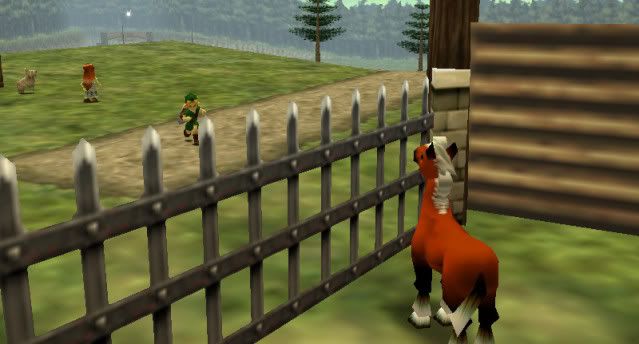
Anyway, upon entering Romani Ranch, you see Epona in a pen next to the farm house! Yay! Skullkid didn't kill her after all! Romani, the farm girl (who shares a sprite with kid Malon from OoT) evidently found Epona and has been keeping her safe for you. Isn't that great?
"Them."

She teaches you Epona's Song and then explains that she needs a little bit of help around the ranch. No big deal - it's just that every year before the Carnival, all of their cows get abducted by "them." She explains that they come down in a ball of light and take the cows right out of the barn. This year, she's taking steps to prevent it, so she needs some help from you in driving them off.

This sidequest basically consists of you waiting around the ranch until 2 AM, at which point aliens come down from their ship and slowly float towards the barn. They look basically like how you would expect floaty ghost aliens who steal cows to look. Anyway, you hold them off by pegging them with arrows, and in the morning everyone is very grateful and you get a bottle of milk from Romani. Hooray! There are some other things you can do here, including marching around with a bird mask in order to magically age some chickens for a guy with a mohawk, but that's all part of the joy of playing this game yourself.

Funny that Link never thinks to call a doctor or something. 
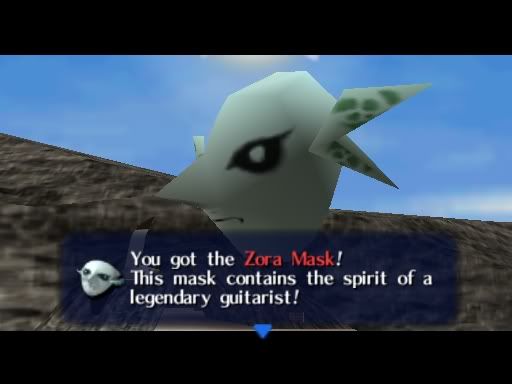
Once you successfully enter the Great Bay Coast, you notice some seagulls floating around a Zora who is stranded in the water. Push him to shore, and he'll explain that his name is Mikau, the guitarist for the popular band the Indigo-Gos. He explains that he was mortally wounded trying to save some Zora eggs that the singer of his band, named Lulu, recently laid. The eggs were stolen by an all-female group of pirates who have a fortress nearby. He begs you to save the eggs in his place, and then in typical fashion, Link turns him into a mask. Nice guy.

This next part of the game is actually sort of entertaining - in the spirit of invading the Gerudo Fortress in Ocarina of Time, your task is to enter the Pirate's Fortress incognito and save the four Zora eggs that are there by sneaking around and not being caught. The pirates are sprite doubles of the Gerudo, and have stolen the eggs in an attempt to get into the Great Bay Temple. Apparently, Skullkid was there and told them that the eggs were crucial to getting in. It's kind of amazing that anybody listens to a freaky-looking guy made of wood with a scary mask on, but I guess these are trusting folk.

After you get the four eggs from the pirates (and their prized treasure, the hookshot - apparently Link can't help looting a bit wherever he goes,) you have to rescue three more from some giant sea eels with the help of a magical golden seahorse. The seahorse was captured by a gross old fisherman who decides to trade it to you in exchange for a pictograph of one of the female pirates, which just goes to show that Link is not a big 'moral standards' kind of guy.

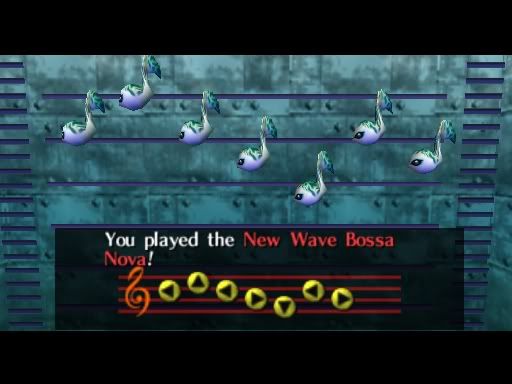
Anyway, once you save all the eggs and reunite the seahorse with his girlfriend, you take the eggs to the Marine Research Lab, where they all hatch together. Interestingly, baby Zoras look remarkably like music notes and they arrange themselves into a song. It's totally weird, but by this point in the game, you should be pretty much used to it. This song will allow you to get into the Great Bay Temple.

Next time: the temple, finally. Also, a horse race and some mummies.

Wednesday, September 21, 2011

Majora's Mask Part 2: Link moonlights as a medium, leaves an old man to freeze to death, impersonates a dead guy, and murders Biggoron.

After the exciting events at the Woodfall Temple, your next stop is the mountains - specifically, Snowhead Temple. But, because this is Majora's Mask, nothing is straightforward. Link's got a few stops to make first.

One of the great things about Majora's Mask is that while you're certainly directed to one place or another, there is a certain level of exploring that you have to do before you can get where you need to go. The mountains are a large area, including a hub area with a little house owned by swordsmiths, the Goron village, and the path to Snowhead Temple. The way Link is now, he's not equipped to even get near the temple, so exploring it is.

"Seriously, Link, just step off the cliff into the abyss. It'll be totally fine."
As you explore the Goron village, you run into Kaepora Gaebora, the helpful sage owl from Ocarina of Time and several other Zelda games. Being the nice guy he is, he directs you to jump across some invisible, slippery blocks to a floating ice cave with no direction on where to step except for a few feathers. He does mention that there's something cool in the ice cave, though, and he's not lying - inside is the Lens of Truth, a late-game item from Ocarina of Time.


On the way back out from the ice cave, Link sees a little shadow on the ground. After whipping out the ol' Lens of Truth, you come face to face with a dead floaty Goron. He's pretty much as surprised as you are about the whole "I see dead people" situation and asks you to follow him.

After chasing him around the village and finally up a sheer cliff face with invisible ladder rungs, you find another cave (apparently Gorons love the whole cave thing) with the dead guy's grave in it. Apparently, his name is Darmani, and he's some kind of Goron hero. He got blown off a cliff face while trying to reach Snowhead Temple and died, which sucks for him. He asks you to "heal" him, and in response Link plays the Song of Healing (which the Happy Mask Salesman taught him). This turns Darmani's soul into a mask, which seems a bit less like healing and a bit more like sealing a dude in a mask for all eternity, but hey, we have to trust that a guy who is totally dedicated to collecting masks even if they can end the world wouldn't have any ulterior motives in teaching Link a song that turns people into masks.

Whatever.

Anyway, now we have the Goron mask. Link's Goron form can punch things, ground stomp, roll really fast, and lift and push heavy things. It is also very slow when walking, can't jump or climb very well, and drowns instantly in water. It'll serve as your powerhouse form, but doesn't have much finesse.

All the Gorons in the village now refer to you as Darmani, and they're understandably surprised to see you, seeing as Darmani is dead and everything. It turns out that the winter has gone ugly in Snowhead, threatening to freeze even the Gorons to death. Worse than that, the Goron village is filled with the sound of the world's most irritating crying from the son of the Goron elder, who is missing his father. Your task is clear - stop the kid from crying by finding the kid's father. Off you go.

Sucks to be this guy.
When you finally find the kid's dad, he's frozen in an ice block. You have to thaw him out using hot spring water from Darmani's grave, which is hard because hot spring water cools off quickly. After several inevitable screw-ups, you thaw the elder out. At first he refuses to believe you're real, since Darmani is dead, but once he discovers that his son is having the world's most annoying temper tantrum, he agrees to help you out by teaching you the Goron's Lullaby. Or, at least he tries to - he can only remember the first part of the song, since he's all old and was frozen in an ice block and stuff.

You'd think Link would take this opportunity to maybe save the Goron elder, but this isn't Link's style. Instead, you motor back to the Goron village and play the intro to the crying kid, who teaches you the end of the song. Once you play it to him, he falls asleep - along with all the other Gorons in the area. The usefulness of this will be apparent later.

A massive Goron who blows at you to stop
you from getting into the temple. Also,
he's invisible. Good thinking, Nintendo!
Anyway, since Link has what he needs to get to the temple now, off he goes. When you make it to the narrow path to the temple, the first thing you notice is a wind gust coming from somewhere which pushes you off if you try to approach. Using the Lens of Truth, you see that the wind gust is coming from a massive, invisible Goron, who is apparently trying to protect the temple from intruders. (This is one of the dumbest things I have ever seen in a game, and it is also never explained. I guess they just really, really wanted to use that Biggoron sprite from OoT.)

The natural response from Link is not to try to reason with the big, invisible Goron, but instead to murder him. That's our boy! By playing the Goron's Lullaby, you make Biggoron fall asleep and roll into the deep gorge below, landing at the bottom some time later with a mighty thud. (Comment from Anonymous: When you finish the snowhead temple and go back to the temple, biggoron is well and alive and you get to speak to him. He says that apparently he was being possessed by something in the temple, forcing him to do what he did.) So we can all be pleased that Link isn't going to jail! Hooray!

Snowhead Temple's main room.
Snowhead Temple itself is largely comprised of a central hub room with multiple levels - taking advantage of the much greater draw distance and reduced fog, you can see clear down to the bottom floor and up to the top floor at all times while in this room. The action mostly centres around climbing up and down the tiers of this massive temple, using the Goron form's fast rolling speed to jump across great distances. The item you get from this dungeon is the Fire Arrow - just like in OoT, it melts ice and lights stuff on fire. It's awesome.

Once again, the enemies are well-designed for the temple, the rooms are expansive and distinctive, and the puzzles are mostly driven by the complex temple layout rather than individual room-based challenges. It's not my favorite of the four temples - the music is a bit grating and the uniform look of the hub room means it's hard to keep track of where you are, where you've come from and where you're supposed to be going.

The boss of Snowhead Temple is Goht, who is a mechanical goat. (Thus the name). Beating this boss is fun, if overly simple - in Goron form, you roll around after Goht as he runs in front of you, hitting his legs with your body and dodging the bombs, boulders, and other obstacles which he tosses in your way. He occasionally gets faster and starts throwing more stuff at you, but it's largely straightforward.

After you beat Goht, you return to psychadelic bubble world and meet another Dahl-esque giant. Tatl asks the question that we all want to, except more politely  - "what exactly are all of you?" to which the giant replies "Guardians." Tatl surmises that the giants are protective gods, which explains why they're in the temples.

Link and Tatl are booted out of rainbow bubble land, and you're treated to a lovely cutscene of the snowstorm stopping and the ice and snow melting from Snowhead and the surrounding area. As usual, when you save, everything reverts to the way it was - except this time, you have Goht's Remains, the item proving that you've freed the giant from the Snowhead Temple.

Next time - Link saves cows from aliens, raises an invisible soldier's self-esteem, raids an all-female pirate fortress (and not in a National Lampoon way), rides a giant sea turtle, and kills a Zora guitarist. Stay tuned!

Monday, September 19, 2011

Majora's Mask Part 1: Dekus, Gorons and massive, bodiless singing giants, oh my!

South Clock Town, dominated by the aforementioned
Clock Tower.
After the Happy Mask Salesman's little temper tantrum and subsequent quest-imparting, you end up in the main hub of Majora's Mask - Clock Town, like I previously mentioned. The only really important stuff that happens here is sidequest-related, so largely it serves only as somewhere to start at after restarting time.
The first thing you'll notice is that, as a city, it's much larger and more vibrant than anything in Ocarina of Time - there are many more shops and independent buildings here, loads of townspeople going about their business, and a much more organic atmosphere. This is largely a result of the increased RAM allowance now that the Expansion Pak has been installed, and it really changes the entire feel of the game.

The Southern Swamp
You may also notice that many of the townspeople are on their own schedules, independent from yours - for example, the innkeeper, Anju (who uses the same sprite as the Cucco lady from Kakariko village in the previous game) moves around the city and the inn depending on which day it is and what time of day it is. Many of the sidequests require you to find and speak to people at certain times of day (or night,) so it adds a lot of interest to the gameplay. Even the weather changes from day-to-day - for example, the first day is sunny, the second day it rains, and the last day is punctuated by occasional earthquakes. 

Your first order of business, like Tatl mentioned, is to check out the Southern Swamp, accessed by leaving town from the south gate. (Logical.) Now that the Mask Salesman has changed you back into a human, your Deku scrub form is available to you by means of the Deku Mask - you can put it on and take it off almost anytime. There are around two dozen masks in the game, some optional, some not, and all with their own unique powers. The Deku form, for example, lets you hover for a short time and blow magical spit bubbles (I know, I know) which can come in handy in a variety of situations.

The Deku Palace Gardens. Make sure you have a
stress ball nearby.
There are only four temples in the game, so to create length and interest, it takes the completion of several quests in order to access each one. After you complete the right quests, Link will learn an Ocarina song which will allow you to enter the temple, and most of the time he'll gain a new mask which will allow him to change forms or gain a new power. Some of the quests can be tedious, mostly because they often require a lot of backtracking to get items or masks that you didn't know you needed. 
 
In order to get into the first temple, for example, Link saves the witch Koume, who has been knocked out by Skullkid, with one of her sister Kotake's potions. Then, some adorable white monkeys tell Link that their brother has been imprisoned by the Deku King under suspicion of kidnapping the Deku Princess. Link, being the great guy that he is, goes to save the monkey, which involves traversing a couple of Hyrule castle-style mazes in Deku form. If you get spotted by the guards, you have to start over. I don't think I need to tell you how old this gets.
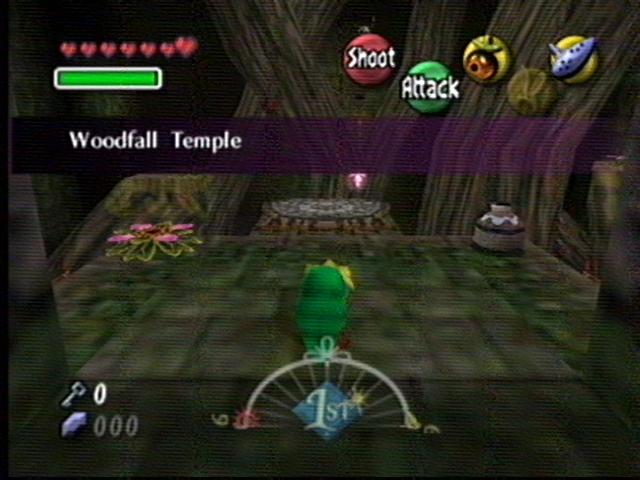
Woodfall Temple as Deku Link. You can see a Deku Flower
in the top left, which lets Deku Link hover.

After you do all this, you find the monkey, who tells you that the princess has actually been captured by a monster in the Woodfall temple and that you should probably go save her. (Go figure.) He teaches you a song that will let you open the temple, and then you get caught by the guards and kicked out. Stupid guards.

The temples in Majora's Mask can be hard, although much of the difficulty comes from non-linear layouts rather than head-scratching puzzles. The Woodfall temple is straightforward, though, and has incredibly unique and well-designed rooms and music. A lot of attention was paid to location-appropriate enemies and obstacles, which contributes to an immersive (if sometimes really, really frustrating) experience.

I'm going try my best to ignore the uncomfortably racist
pseudo-African look of Odolwa in favor of gently
reminding my audience about the importance of sensitivity.
All the temples follow standard Zelda format - there are a few rooms in which you have to defeat several enemies to open new doors, all temples have at least one mini-boss, and you have to collect the boss key to proceed to the end. All the temples also feature small keys, maps, and compasses to help you on your way.

There are new, species-specific obstacles as well - Deku Link can use Deku Flowers to hover or hide from enemies, Goron Link can smash large switches and push blocks that regular Link can't, and Zora Link can swim and breathe underwater.
The bosses in Majora's Mask range from hilariously easy to stupidly difficult, but all four of them are totally unique experiences. The first boss, Odolwa, is the only one which you can fight without the aid of at least one mask, and the arena in which you fight the bosses range in size and style. (You have to become a giant to fight one boss, which is awesome in a Godzilla kind of way.)

Link, what did I tell you about cough syrup?
After you complete Woodfall temple, you are teleported to a bizarre bubble world and come face-to-face with what I can only describe as a massive head with long, spindly arms and a decidedly Roald Dahl-esque look. It (he? She? Zhe?) teaches you a song and instructs Link to "call us." I wish I could tell you that's the last time you see these freaks, but there are four - one for each temple - and they ultimately save your ass from being crushed by a giant, angry moon. It's all par for the course, honestly.

You're given the item "Odalwa's Remains," rescue the Deku Princess by stuffing her into a tiny glass bottle (I don't even know) and then free the monkey from his execution at the hands of the Deku King. The swamp, which previously had poisoned water, is all healthy again and whatnot, and you saved the day! Isn't that great?

And I thought the Wind Fish was bizarre.
Except not really. This is where the dark side of Majora's Mask comes in - once you return to the first day in order to save, everything goes back to the way it was. Nobody has saved the princess yet, the monkey is still about to be executed, Koume is still dying alone in the forest, and the swamp is still full of poison. The only things that you retain are the songs you've learned, the key items you've gained, and Odolwa's Remains. You've saved the giant which was trapped inside Odolwa's Remains, but nothing else has been resolved.

But, you only have three days to save the world, so you can't help them. Instead, you're forced to move on to the next area if you want to get all the giants to help you stop Skullkid.

With that happy thought, stay tuned for the next section of Majora's Mask - Snowhead Temple.